Research Projects

DUST
Distributed Unit for Sorting and Transport – Rover Prototype for Regolith Mining
Start: 03/2025
End: 11/2025

The DUST project, short for “Distributed Unit for Sorting and Transport,” focused on developing a mobile robot system for the (partially) autonomous extraction of lunar sand, known as regolith, in space. As part of this project, a rover was built and tested that can also sort and transport the extracted material within the same system. The goal was to save valuable resources in the future.
Manned space missions are complex and costly. The use of mobile robot systems is intended to ease the burden of these missions, reduce costs, and enable the efficient use of available resources. The DUST rover could be used to extract regolith, a loose material found on the surface of rocky planets such as the Moon.

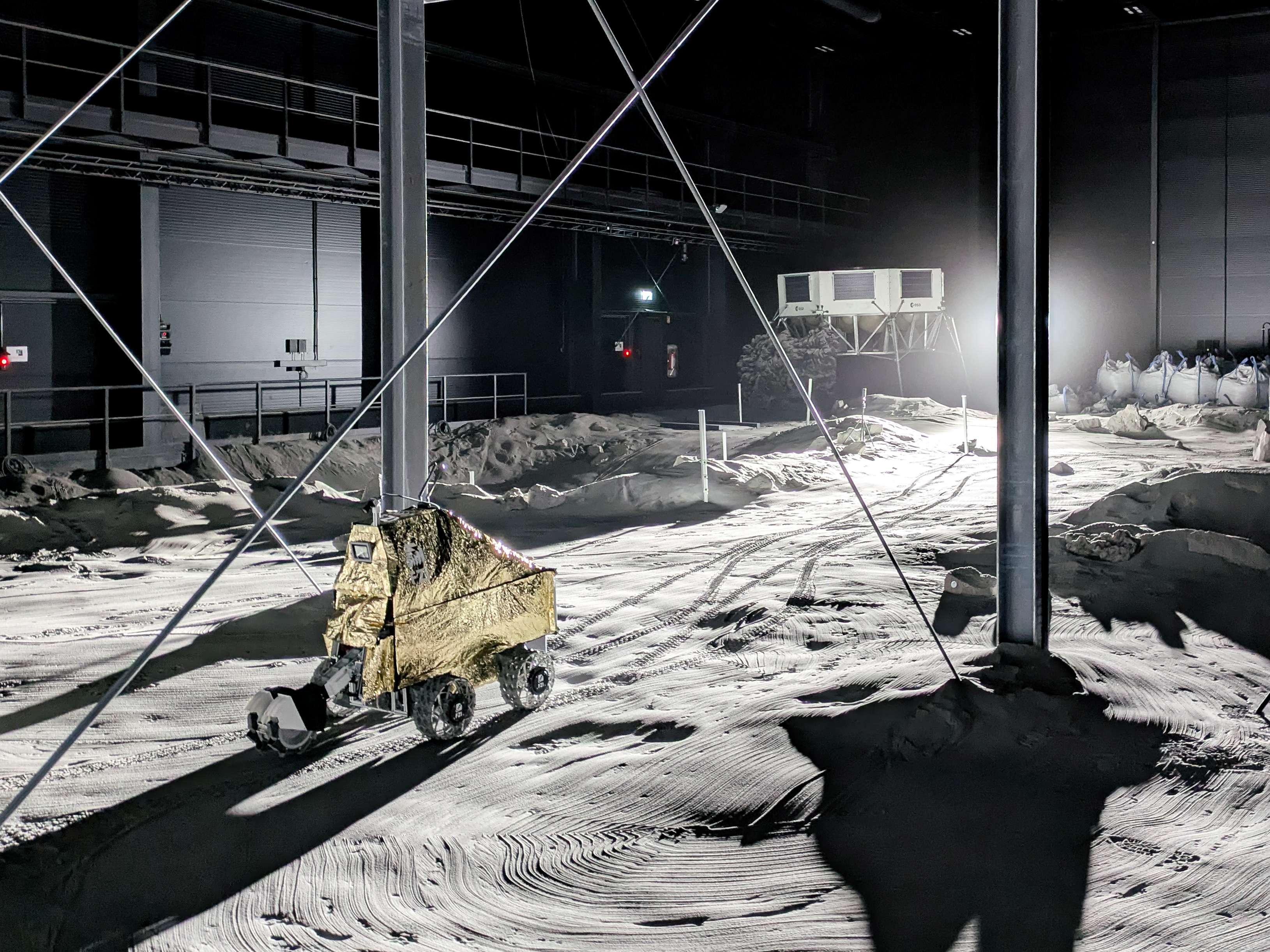
The approach pursued by FZI is based on a wheel-driven and teleoperated robot equipped with a bucket wheel excavator and an integrated processing unit for grain classification. An additional camera mast provides an overview of the area of operation and is used to remotely control the robot.

The prototype was built and tested as part of the ESA-ESRIC Space Resources Challenge. An exemplary mission sequence with the DUST rover took place at the LUNA Moon Center in Cologne and began with the selection of a suitable mining area based on camera images.

This enabled an energy- and risk-minimized route to be planned, and the robot then manually navigated to the target area. Optional particle distribution tests could be carried out here. The automated digging process then began, while the material was already being processed in parallel. Since regolith particles are sharp-edged and prone to clogging, special measures were integrated to prevent blockages, including vibration mechanisms and the option to interrupt the screening process temporarily. After completing the excavation, the robot returns to base, where the screening is completed, and the extracted regolith fractions are finally measured.

The resulting rover prototype enables scalable and efficient resource extraction with the aid of a mobile robot system. The project thus contributes to the preparation of future manned lunar missions and to the development of robust, practical robot systems for extreme environments.

Role of the FZI
As part of the project, the FZI took on key tasks in the design, implementation, and testing of the rover. Initially, the FZI was primarily responsible for the conception and design of the rover. The aim was to design a robust and powerful system that could meet the requirements of the planned application scenarios within the framework of the ESRIC Challenge. Building on this, the FZI also took on the construction of the rover. This was followed by participation in the challenge at the LUNA Moon Center in Cologne.

Contact person
Staff
Division: Intelligent Systems and Production Engineering
Headquarters Karlsruhe

Research focus
Applied Artificial Intelligence

In this research focus, the FZI concentrates on practical research into the key technology of Artificial Intelligence (AI). Innovative AI solutions are developed and transferred to application areas such as mobility, robotics, healthcare technology, logistics, production, and supply and disposal on behalf of our partners and customers.

Funding notice:
The project was not supported by external funding.

Go to Top