

Fact-Checking across Language Barriers: AI Assistant Detects Disinformation in German, Russian, and Turkish
Project kuKI launched
Research Focus: Applied Artificial Intelligence, Digital Society
Germany is a multilingual society – yet so far, analysis of disinformation has focused almost exclusively on German. As part of project kuKI, an interdisciplinary team of researchers, journalists, and civil society representatives is developing an AI assistant that can detect and classify disinformation in German, Russian, and Turkish for the first time, and support countermeasures.
Manipulative information campaigns specifically target population groups with different cultural backgrounds and often make use of their native languages. While technical solutions and media literacy initiatives have made progress in recent years, clear limitations are becoming apparent:
“We see that existing AI systems often overlook disinformation when it is culturally embedded. kuKI closes this gap by integrating language, context, and societal perspectives”
Dr. Jonas Fegert, Project Manager, FZI Research Center for Information Technology
A prominent example is the propagandistic narrative of “denazification” in the context of Russia’s war of aggression against Ukraine. It draws on historical and cultural references that go beyond a purely German- or English-language understanding of Nazism. Such narratives often go unnoticed in common AI systems and even in fact-checking.
Technological innovation: a language model with an understanding of cultural context
The project focuses on developing a culturally sensitive language model that is free of Western bias and capable of understanding cultural nuances.
“Language models contain cultural biases because their training data reflects certain perspectives more strongly than others. Through context-specific training, we consciously manage these biases and make them visible as analyzable biases. This is an advantage over many common models whose data sources are not transparent,” explains Prof. Achim Rettinger from the University of Trier. Dr. Isabel Bezzaoui of Goethe University Frankfurt adds that current taxonomies for detecting disinformation focus on major languages, particularly English. “However, when these communication patterns and analytical frameworks are automatically transferred to other linguistic contexts, linguistic and cultural nuances are often overlooked – even though these can be decisive for the dynamics and effectiveness of disinformation campaigns.”
Integration in CeMAS monitoring and CORRECTIV.Faktenforum
As part of the project, the non-profit Center for Monitoring, Analysis and Strategy (CeMAS) is expanding its monitoring system to include Russian- and Turkish-language Telegram, YouTube, and TikTok channels. “Our analyses to date show how extensively disinformation networks operate across platforms and languages. With kuKI, we can systematically visualize these interconnections for the first time – and simultaneously analyze narrative patterns across linguistic regions. This allows us to understand not only who is spreading disinformation, but also where and how it is effective and how it adapts to different cultural contexts,” said Josef Holnburger, Executive Director of CeMAS.
The tangible result of the project will be an AI assistant that CORRECTIV, a media organization dedicated to the public good, will integrate into the CORRECTIV.Faktenforum. CORRECTIV operates an independent fact-checking editorial team. With the CORRECTIV.Faktenforum, it also offers the first participatory project in the German-speaking world that involves people in the entire fact-checking process. Citizens can submit potential disinformation there, discuss it, and research it under the editorial guidance of CORRECTIV. With the help of the automated translation function, CORRECTIV will enable this exchange in German, Russian, and Turkish in the future.
To ensure the multilingual fact-checking initiative succeeds, representatives from the Russian- and Turkish-speaking communities are involved in its further development: “With the CORRECTIV.Faktenforum, we actively involve people in the fact-checking process while simultaneously building a structured dataset of false claims and facts. We are now applying this approach to a multilingual context,” says Caroline Lindekamp, Director of Fact-Checking at CORRECTIV. “This allows us to identify narratives from different linguistic regions earlier and analyze them systematically. The project combines participatory approaches with journalistic standards and AI-supported analysis, thereby creating a unique foundation for combating disinformation across languages.”
Open science for sustainable impact
The project partners are documenting the methodology in line with an open science approach, making it accessible wherever possible. This ensures that the methods developed in the project can have an impact beyond the consortium and can be applied to other language groups in the future.
For the first time, the project is analyzing disinformation dynamics across languages and addressing them in collaboration with the affected communities. By doing so, kuKI is establishing a new foundation for the effective identification of disinformation in an increasingly multilingual society and is contributing to the sustainable strengthening of democratic public discourse.
For the first time, the project is analyzing disinformation dynamics across languages and addressing them in collaboration with the affected communities. By doing so, kuKI is establishing a new foundation for the effective identification of disinformation in an increasingly multilingual society and is contributing to the sustainable strengthening of democratic public discourse.
About the project
The project kuKI, short for “Kulturalisierungssensible KI-Assistenz für eine desinformationsresiliente multilinguale Gesellschaft” (Culturalization-Sensitive AI Assistance for a Disinformation-Resilient Multilingual Society), is funded by the Federal Ministry of Research, Technology and Space (BMFTR) from March 2026 to March 2029 with a total of 3.18 million euros.
Dr. Jonas Fegert, FZI, leads the kuKI project, supported by Cosima Pfannschmidt, FZI, as project coordinator. Further information on the new funding initiative “Desinformation − Erkennen. Verstehen. Abwehren (Disinformation – Recognize. Understand. Defend)” by the Federal Ministry of Research, Technology and Space (BMFTR) can be found (in German) under the following link: https://www.forschung-it-sicherheit-kommunikationssysteme.de/service/aktuelles/auftakt-in-berlin-elf-forschungsprojekte-gegen-desinformation-gestartet
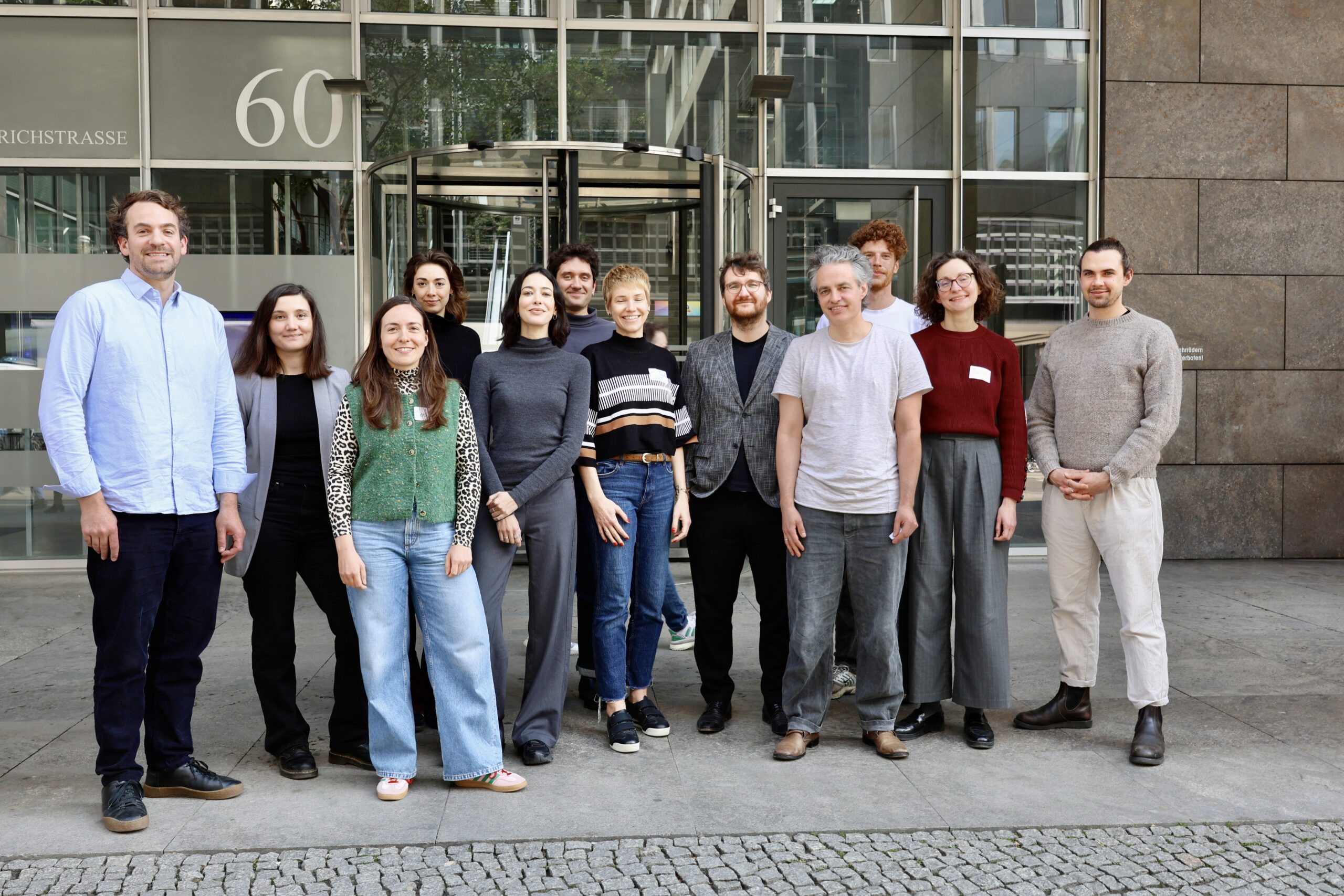
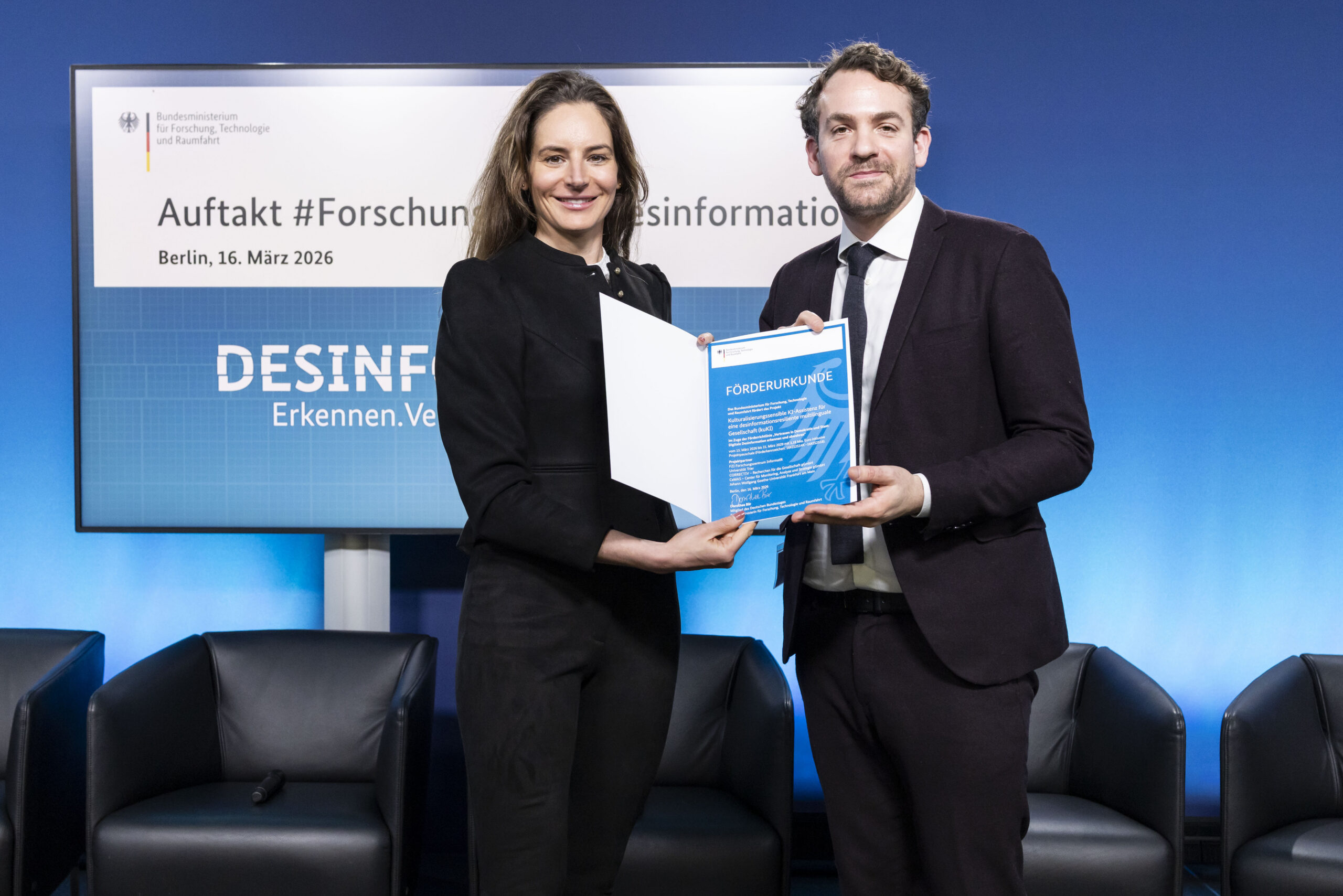
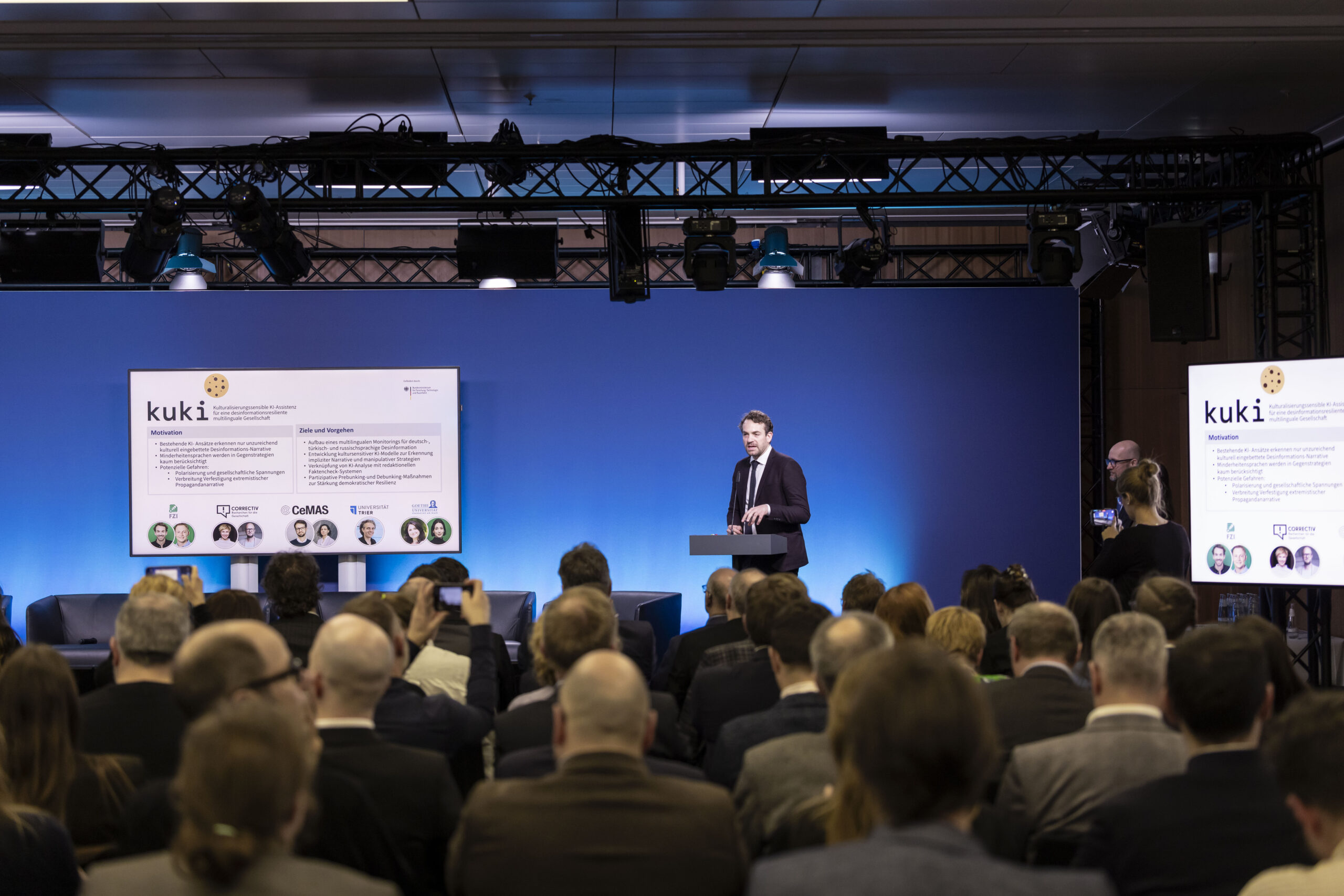
The project consortium
FZI Research Center for Information Technology (Consortium Lead)
The FZI Research Center for Information Technology, headquartered in Karlsruhe with a branch office in Berlin, is a non-profit institution dedicated to applied computer science research and technology transfer. It brings the latest scientific findings in information technology to businesses and public institutions and prepares students for careers in academia and industry or for the transition to self-employment. Supervised by professors from various faculties, the research groups at the FZI develop interdisciplinary concepts, software, hardware, and system solutions for their clients and implement the solutions as prototypes. The FZI House of Living Labs provides a unique research environment for applied research. With the House of Participation, it operates a center of excellence for digital democracy under the scientific direction of Dr. Jonas Fegert. The FZI is an innovation partner of the Karlsruhe Institute of Technology (KIT) and a strategic partner of the German Informatics Society (GI).
Project Management
Dr. Jonas Fegert
Phone: +49 30 7017337-338
Email: fegert@fzi.de
CeMAS – Center for Monitoring, Analysis & Strategy gGmbH
As a nonprofit organization, CeMAS brings together interdisciplinary expertise on topics such as conspiracy ideologies, disinformation, antisemitism, and right-wing extremism. Through systematic online monitoring and modern research designs, CeMAS analyzes current developments to derive innovative strategies.
Further information
Gregor Bauer
Email: presse@cemas.io
Website: www.cemas.io
CORRECTIV – Recherchen für die Gesellschaft gemeinnützige GmbH
CORRECTIV is a public-interest media organization that strengthens democracy through journalism, media education, and technology. As a multi-award-winning newsroom, CORRECTIV is committed to investigative journalism, sparks public debate, collaborates with citizens on research projects, and contributes to society through its educational programs.
Further information
Caroline Lindekamp
Email: caroline.lindekamp@correctiv.org
Email: presse@correctiv.org
Website: www.correctiv.org
Goethe University Frankfurt
Prof. Dr. Galina Putjata
E-Mail: presse@uni-frankfurt.de
Internet: www.uni-frankfurt.de
Trier University
Prof. Dr. Achim Rettinger
E-Mail: presse@uni-trier.de
Internet: www.uni-trier.de
Press contact
Frieda-Sophie Lammert
Communications
- +49 721 9654-928
- presse@fzi.de
- Headquarters Karlsruhe
Further downloads & links:
- Interview with Dr. Jonas Fegert at the conference "Desinformation Erkennen. Verstehen. Abwehren." of the BMFTR on March 16, 2026, in Berlin
- CORRECTIV.Faktencheck
- Center for Monitoring, Analysis and Strategy
- Department of Computational Linguistics and Digital Humanities at Trier University
- Research group Multilingualism and Migration at Goethe University
- Funding initiative „Desinformation − Erkennen. Verstehen. Abwehren.“ of the Federal Ministry of Research, Technology and Space (BMFTR)