
Autonomous Driving: Public Transportation Sector Develops Cross-Sector Platform MILA.mobility
The Federal Ministry of Research, Technology and Space is funding Germany's largest collaboration, involving 30 partners from transportation companies, industry, academia, and associations.
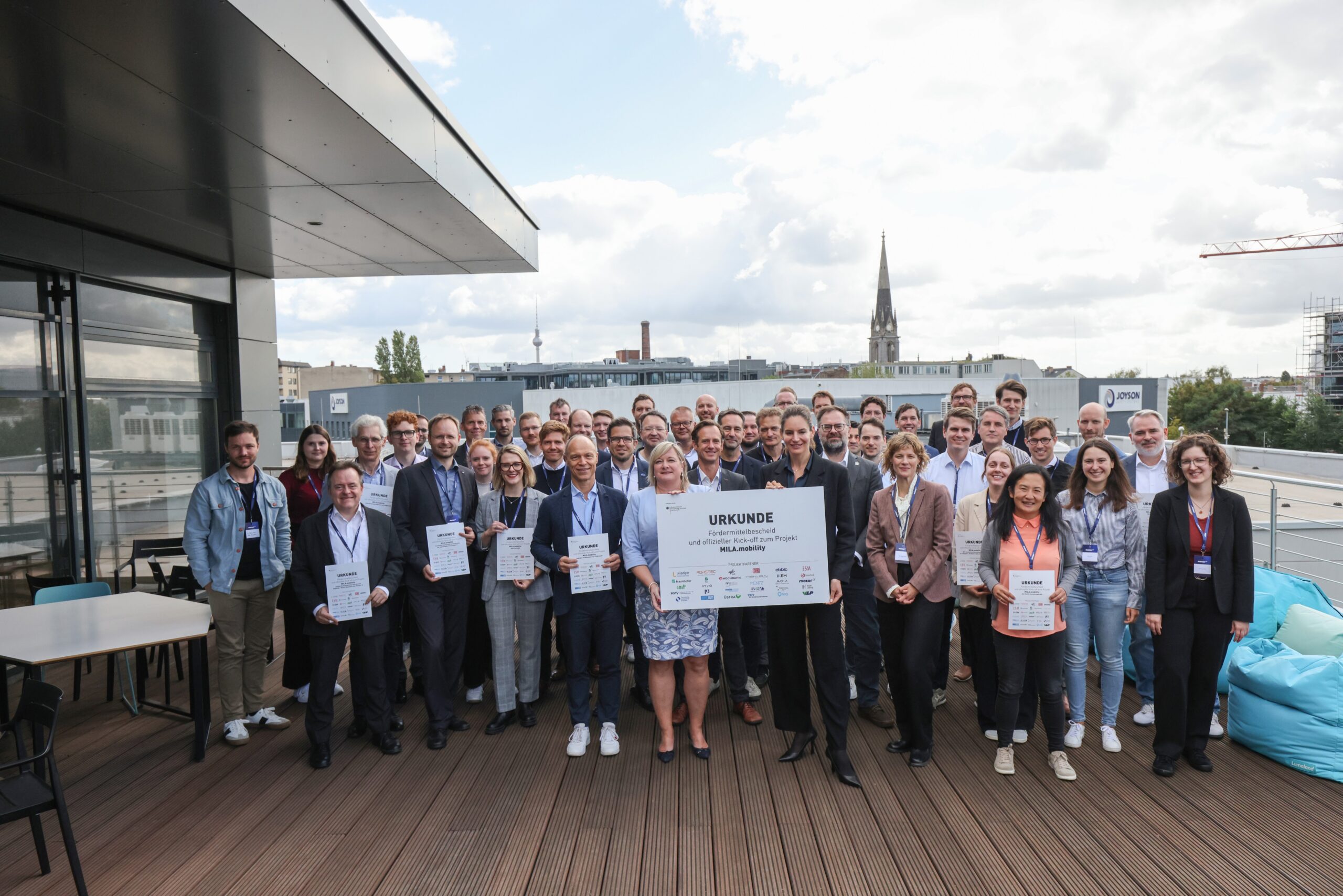
With the official project launch in Berlin, MILA.mobility began its joint development phase today. This nationwide research and development project is creating an open, manufacturer-neutral platform designed to connect autonomous vehicles with existing control center, dispatch, booking, and infrastructure systems in public transportation. The goal is to move autonomous mobility services beyond their current status as isolated, standalone solutions and make them viable for widespread use in public transportation. “Germany aims to become the leading market for autonomous driving. The German public transportation sector aspires to be a central component of this leading market. To achieve this, we need common standards and solutions that can be efficiently utilized and economically implemented by as many partners as possible. MILA is an important building block on this path. Taking on the role of consortium leader for this project is both an honor and a responsibility for us. Together with our partners, we want to bring together experience and insights from research and practice and make them available to the entire industry,” says Ulf Middelberg, Managing Director of Leipziger Verkehrsbetriebe, which is serving as the consortium leader for the industry project.
So far, autonomous driving projects in Germany’s public transport sector have largely remained within closed systems. However, if vehicles, control centers, and software do not work together reliably—and if lessons cannot be learned from other projects—this leads to costly customizations and inefficient duplicate structures. A lack of standards makes it difficult to switch providers, increases implementation costs, and slows the transition from pilot operations to regular service. This is exactly where MILA.mobility comes in: It is developing an industry platform with an open, vendor-neutral system architecture. In the future, this will make it easier for transit agencies to integrate autonomous vehicles from different manufacturers into their existing systems. This enhances interoperability, simplifies procurement and further development, and improves the conditions for reliable operation.
“For years, the RMV and DB have been pioneers and trailblazers in autonomous driving in German public transit through the KIRA project. Now it is time to intelligently and efficiently pool the experience and knowledge that we in the Rhine-Main region and other operators throughout Germany have gathered over the years. The goal must be to use MILA to take decisive steps forward as an industry and establish autonomous driving in German public transit,” explains Prof. Knut Ringat, VDV Vice President and Chairman of the Executive Board of the Rhine-Main Transport Association.
Development and testing in three cycles
The platform is being developed in three successive cycles. First, components and interfaces are tested in a virtual laboratory. The results are then gradually refined under real-world conditions in five test sites: in Leipzig, the Hanover region, the Munich region, Ludwigslust-Parchim, and the Rhine-Main region. The test sites reflect the diverse requirements of public transportation. The goal is to demonstrate that vehicles, control centers, and dispatch systems from different providers can work together reliably. Practical experience is continuously incorporated into the further development of the architecture, software, and testing procedures.
FZI tests autonomous driving capabilities across test sites
The FZI Research Center for Information Technology is responsible within the project for the autonomous driving function on INYO Mobility’s vehicles in the Leipzig and Munich test fields. The focus is not only on automated driving, but also on its integration into the operational processes of local public transit. This includes, among other things, the orchestration of vehicle fleets and the remote support of autonomous vehicles via Remote Assistance.
Operating in two test sites enables the FZI to test the autonomous driving function under a variety of local and operational conditions. Cross-site evaluations are also planned to compare the findings from both locations and incorporate them into the further development of the driving function.
Facts, figures, and data about MILA.mobility
MILA is an acronym for the German term “Middleware Integration of Control Center and Dispatch Systems for Autonomous Mobility”. Thirty partners from transportation companies, industry, academia, and associations are working on MILA.mobility. The project is coordinated by Leipziger Verkehrsbetriebe. The Federal Ministry of Research, Technology and Space is funding the project with approximately 33.8 million euros. The total project budget is approximately 57 million euros. The project will run for 44 months and is scheduled to end on March 31, 2030. The project structure combines technical development, scientific support, and operational testing.
The following project partners are carrying out the initiative as a broad alliance (in alphabetical order): ADASTEC GmbH; DB Regio Bus Mitte GmbH; German Aerospace Center (DLR); ebblo Germany GmbH; Eckardt Software Management ESM GmbH; Fraunhofer-Gesellschaft zur Förderung der angewandten Forschung e. V.; FZI Research Center for Information Technology; Hamburger Hochbahn AG; HOLON GmbH; INIT Innovative Informatikanwendungen in Transport-, Verkehrs- und Leitsystemen GmbH; Institute for Climate Protection, Energy and Mobility e. V.; Interlink GmbH; INYO Mobility GmbH; IVU Traffic Technologies AG; Leipziger Verkehrsbetriebe GmbH (network coordinator); MENTZ GmbH; MOIA GmbH; MOTOR Ai GmbH; Münchner Verkehrs- und Tarifverbund GmbH; P3 digital services GmbH; RWTH Aachen University; RPTU University Kaiserslautern-Landau; Rhein-Main-Verkehrsverbund GmbH; City of Leipzig; TUD Dresden University of Technology; Technical University of Munich; ÜSTRA Hannoversche Verkehrsbetriebe AG; Association of German Transportation Companies (Verband Deutscher Verkehrsunternehmen e. V.); Verkehrsgesellschaft Ludwigslust-Parchim GmbH; Via Mobility DE GmbH.
About the FZI
The FZI Research Center for Information Technology, with headquarters in Karlsruhe and a branch office in Berlin, is a non-profit institution for information technology application research and technology transfer. It delivers the latest scientific findings in information technology to companies and public institutions and qualifies individuals for academic and business careers or the leap into self-employment. Supervised by professors from various faculties, the research groups at the FZI develop interdisciplinary concepts, software, hardware and system solutions for their clients and implement the solutions found as prototypes. The FZI House of Living Labs provides a unique research environment for application research. The FZI is an innovation partner of the Karlsruhe Institute of Technology (KIT) and strategic partner of the German Informatics Society (GI).
This press release was provided by the Association of German Public Transport Companies (VDV) and supplemented with information about the FZI Research Center for Information Technology.