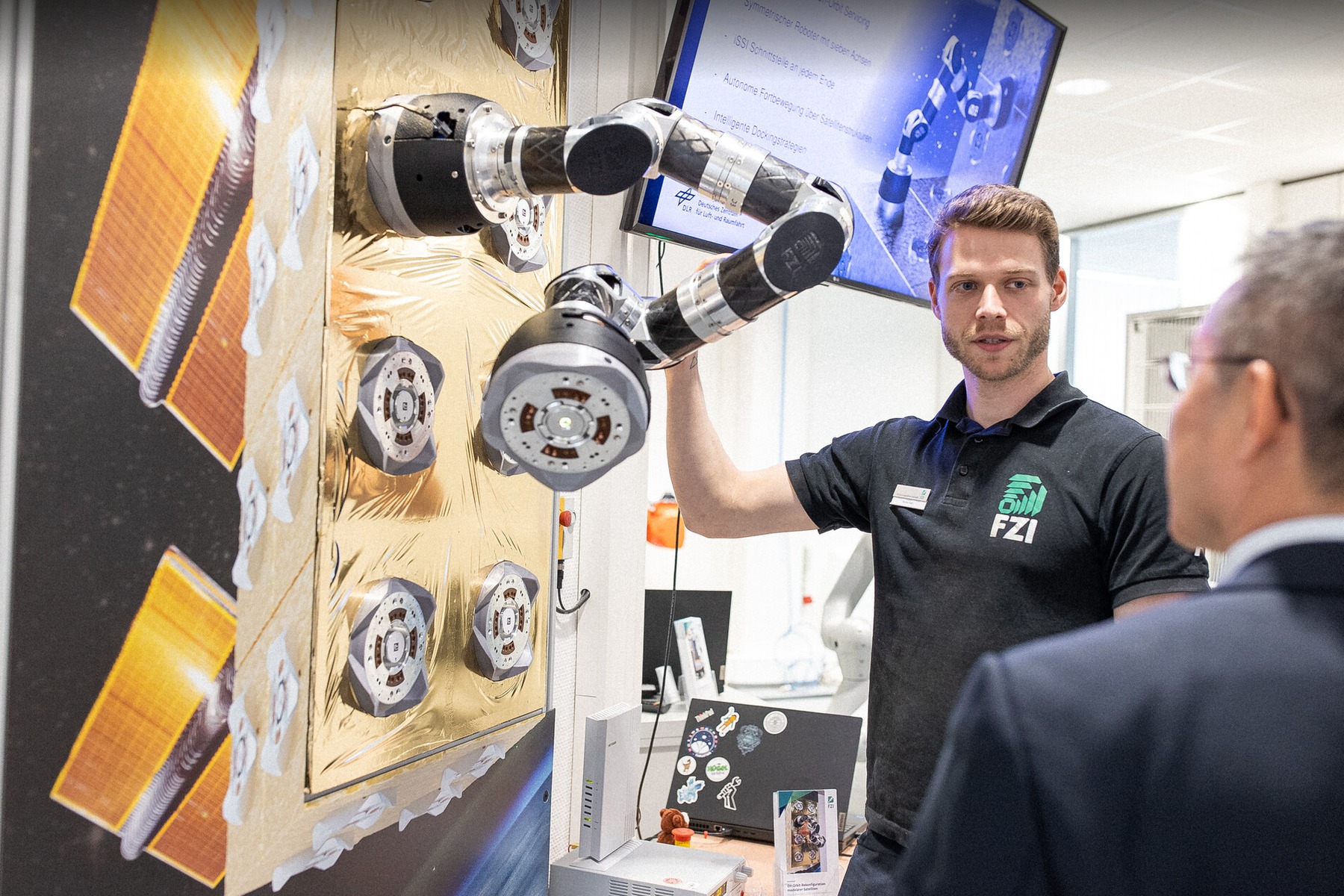

The robotic arm was designed and developed as part of the predecessor project. Initially, the focus was exclusively on the feasibility of the physical requirements (reach, payload capacity, etc.) under terrestrial conditions.
In ReCoBot II, the concept was refined. The focus was on investigating the qualification of individual components for space use. The robotic arm incorporated various components that must function smoothly in space to ensure the overall system’s operability. Various qualification tests were conducted, and the insights gained from them were incorporated into the robot design as the project progressed. In addition to assessing the robotic arm’s suitability for space use, the project aimed to further optimize the robot’s kinematics.
The developed technology can also be applied to other use cases, such as hard-to-reach environments like bridges or utility poles. The ability to climb along structures is unique to this type of robot. This closes a gap in the range of tasks robots can perform.
This included:
– ROS 2 for a future-proof framework
– Application-specific optimization of kinematics and lightweight construction for minimal weight during a rocket launch
– Development of technologies for specific tasks

We develop mobile systems and autonomous walking robots for use in space travel, industry, and public spaces. We put them to the test in the FZI Living Lab Service Robotics.