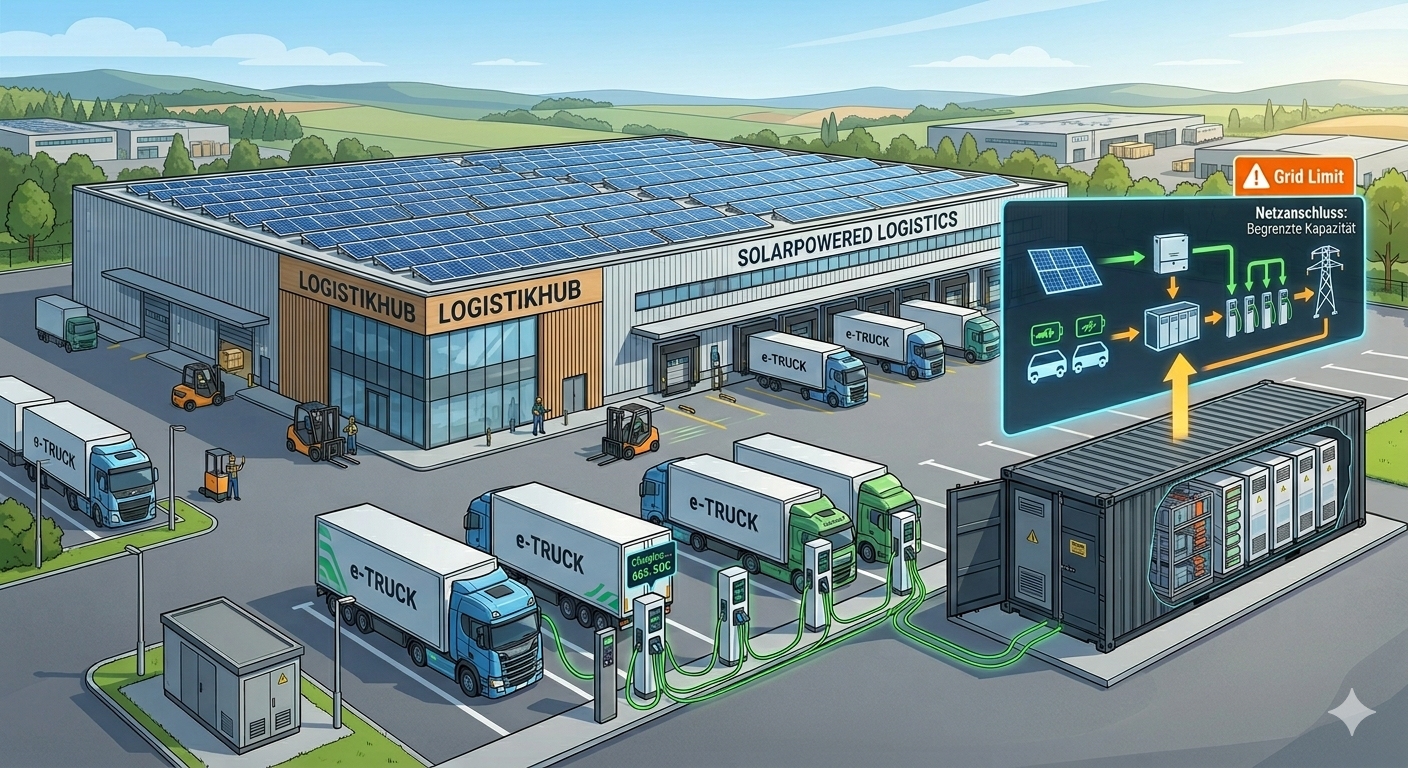

Since depot-based charging is expected to cover the majority of necessary charging processes, even in long-haul freight transport, the creation of cost-efficient and widely available charging infrastructure at logistics sites is essential for the successful energy transition in the transport sector.
The high charging capacities required, particularly by heavy-duty trucks, pose significant challenges to cost-efficient depot charging, especially considering local infrastructure constraints and the dimensioning of the grid connection.
Within the scope of LogiCharge, we investigate how the use of large PV systems on logistics halls, in combination with large Battery Energy Storage Systems (BESS), can ensure that charging demand can be met even during peak load times. To achieve this, the iLMS will prognosis-based pre-condition the battery storage while utilizing the maximum possible share of green electricity to cover the energy demand.
In addition to optimizing the charging processes, we examine how the storage unit can be connected to flexibility markets using a multi-use approach – via Vehicle-to-Grid (V2G) or Battery-to-Grid (B2G) functionalities.
The charging infrastructure installed by the project partner Bidirex GmbH forms the foundation for this holistic energy optimization approach. It includes charging stations up to 420 kW, stationary battery storage, and PV systems. The iLMS optimizes the charging processes of electrified trucks and vans at selected logistics sites by considering a multitude of parameters: route planning information, live telemetry data, current electricity prices, local capacity limits of the on-site infrastructure, and other relevant information.
In cooperation with selected logistics partners, the developed systems will be prototypically tested in practical operation, and their economic viability will be thoroughly assessed. The project thus makes a valuable contribution to a cost-efficient and sustainable decarbonization of the logistics sector.
For this purpose, we develop algorithms and models for the precise prognosis and optimization of energy demand as well as the availability of local energy sources. The functionalities are logically mapped into individual, scalable services. Through a modular design and strict separation of functionality between the services, we ensure the reusability and transferability of the developed solutions to other application areas – thereby guaranteeing their utility far beyond the project duration.

Autonomous shuttles, intelligent logistics, and software-defined vehicles: We use IT to create the connected, safe, and sustainable mobility and logistics solutions of tomorrow.
Sustainability and practical relevance are key: We develop IT innovations for companies that contribute to a climate-friendly and resource-efficient economy.