intelliRISK 3
Reliable long-term autonomy for self-reliant robot teams
Start: 07/2024
End: 06/2028
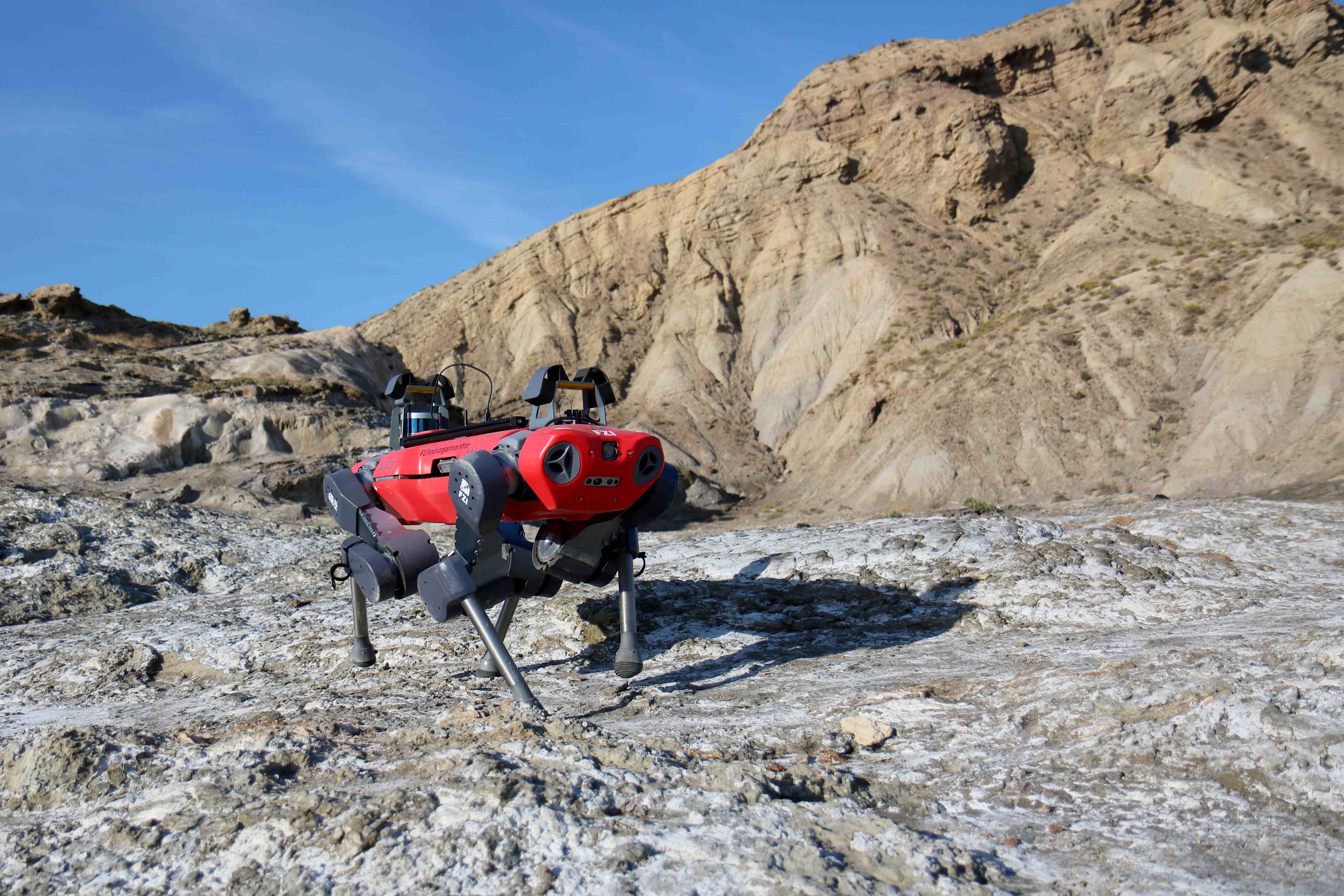
While previous robot-based missions to the Moon and Mars have been successful, they have been controlled largely manually and extremely conservatively due to high costs, complex systems, and unpredictable environments. With medium-term plans for numerous additional missions—such as a permanent lunar base—the need for large numbers of efficient robotic systems is increasing dramatically. The intelliRISK 3 project builds on the intelliRISK and intelliRISK 2 initiatives. These projects have already developed methods and technologies that enable robots to possess active self-awareness and risk awareness, as well as efficient team cooperation. While the focus to date has been on navigation and locomotion in difficult, potentially hazardous terrain, intelliRISK 3 aims to build on these developments and enable even greater robustness as well as long-term autonomy and self-sufficiency of the systems. The focus is particularly on the exchange of self-assessments and risk assessments between the robots. In addition, the robots’ capabilities will be expanded so that they can independently carry out scientific missions—such as the search for resources.
To enable robots to operate with a high degree of autonomy, various methods and technologies were developed in the intelliRISK and intelliRISK 2 projects. These enable robots to actively monitor their own status and assess risks, as well as to cooperate efficiently within a team. Previous projects focused primarily on navigation and locomotion in difficult, potentially hazardous terrain. The intelliRISK 3 project aims to build on these developments. The goal is to achieve even greater robustness and enable long-term autonomy and self-sufficiency of the systems. To this end, existing capabilities for self-assessment and risk assessment will be further developed, with a particular focus on the exchange of this information between robots.
The robots’ capabilities will also be expanded so that scientific missions—such as resource exploration—can be carried out. To this end, the mobile robots are to be equipped with autonomous, force-based manipulation strategies for sample analysis as well as various analytical sensors (spectral camera, XRF). This will allow the entire system to function as a “Multi-Robot Autonomous Field Laboratory.”
As in previous projects, the FZI continues to work independently on the project objectives within intelliRISK 3. The focus is, on the one hand, on expanding cooperation between the robotic systems. This is intended to enable them to collaborate more actively and, at the same time, to minimize the mission's overall risk through mutual support, dynamic task sharing, and rescue operations. As a further aspect of increasing self-sufficiency, a lander base station equipped with solar panels and docking mechanisms for all participating robots is to be designed and implemented.
All these further developments and enhancements will be evaluated by the FZI as part of a fully self-sufficient and largely autonomous 72-hour analog mission in a moon-like environment. The long-term mission represents a critical test and evaluation scenario for increasing the TRL of the systems developed in the intelliRISK projects, as well as a significant step toward application in real planetary missions.