Intelligent mobility starts here
We develop mobility concepts of tomorrow
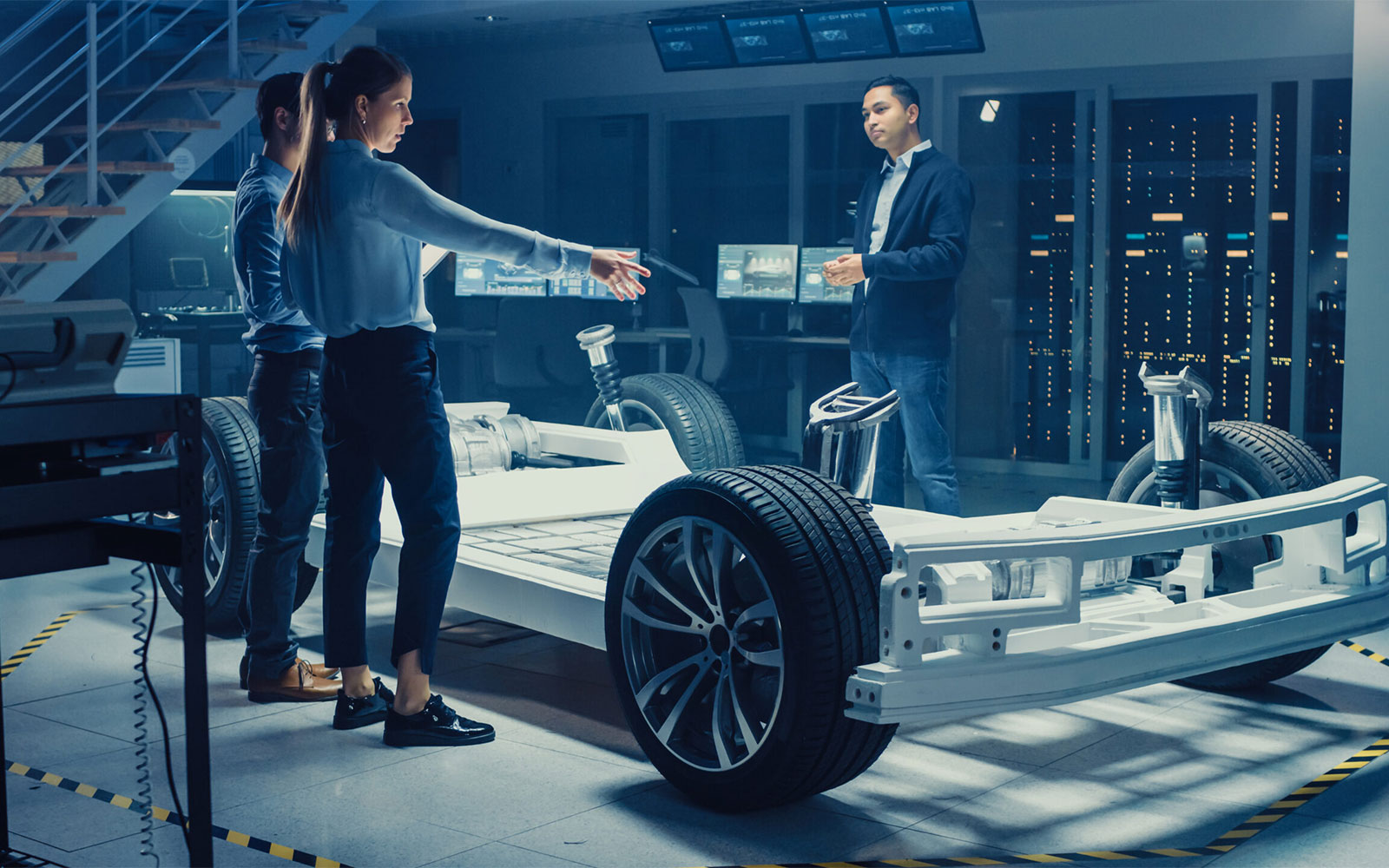
In the FZI Living Lab Future Mobility, we and our partners develop forward-looking software and hardware solutions for intelligent mobility and sustainable transport of the future. Our focus: automated and autonomous vehicles that intelligently perceive their surroundings thanks to state-of-the-art AI systems, Car2X communication, and powerful hardware architectures, and also anticipate traffic situations and move safely in connected road traffic.
From virtual test environments and trials in real laboratories to developing open algorithms, we create a practical environment for research and development.
Contact us if you want to actively shape the mobility of tomorrow.
Mobility solutions for your requirements
This is how we can support you
Take advantage of our customized technologies to increase your efficiency and tap into new potential.
Virtual traffic areas
- Modeling of traffic areas
- Synthetic data sets (camera, LIDAR)
- Example: DigiT4TAF
Measurement and test drives
- Processing and refinement of measurement data
- Evaluation of sensors and algorithms
- Consulting on evaluation concepts for sensor data
- Integration of the required hardware and software
- Consolidation and merge as a study
ROS2-based ecosystems in vehicles
- Implementation consulting
- Driver development for sensors and V2X control units
- Training courses on development and implementation
Connected driving in the Test Area Autonomous Driving Baden-Württemberg (TAF BW)
- Advice on implementing measurement campaigns in TAF-BW
- Development of cooperative driving functions
- Conducting training courses on data analysis for smart transport infrastructures
Automated and connected driving
- Design of test vehicles
- Development of sensor, computer, and activation concepts
- Support with the approval concept
- Use cases
- Operational setup of automated vehicles
- Implementation of PoCs for automated driving
- Connection to customer-specific backends
Open source/open data in automated vehicles and smart infrastructure
- Consulting for sensor data processing
- Workshops and trainings
Multimodal sensor calibration
- Extrinsic and intrinsic calibration for camera, LiDA
- Online sensor calibration while driving for automatic correction of sensor drift and dynamic readjustment
Scene understanding and object semantics
- Semantic 3D environment models from multimodal sensor data (camera, LiDAR, radar) for ODD analysis
- Self-monitored learning for robust object and event classification; reduction of labeling effort
- Domain and weather adaptation for night, rain, fog – including benchmarking and transfer tuning
Safe and risk-aware decision-making
- Formal safety layers (RSS, set-based methods) for real-time verification of planners
- Risk-aware MPC + reinforcement learning for adaptive, non-overcautious driving behavior
Motion prediction and planning with transformer models
- Development of motion transformers for multi-track, heterogeneous scenarios (vehicle + VRU)
- Differentiable coupling of prediction and planning, including real-time optimization on GPU/edge
- Low-redundancy representations for robust prediction even with missing or faulty sensor data
Mapping and localization for autonomous systems
- SLAM-based mapping with camera and LiDAR in urban and unstructured environments
- High-definition maps for autonomous vehicles: creation, updating, and management of semantic maps
- Real-time localization with multi-sensor fusion for high-precision vehicle tracking (GNSS, odometry, visual odometry, LiDAR matching)
End-to-End driving model
- Training of sensor-to-action networks (camera, radar control commands) based on real and synthetic data sets
- Development of safety monitoring architectures for E2E models
- Prototype implementation on test vehicles
Test subject studies UX and user acceptance
- Conducting user studies in the field of human-machine interaction, for example., in human-robot interaction or driver-vehicle interaction
- Investigation of ergonomics, user acceptance, and user experience
- Study planning and implementation
Flexible, project-based, or long-term
This is how you can collaborate with us
Whether you need short-term project support or a long-term strategic partnership, we offer various cooperation models tailored to your needs.

Project-based cooperation
Services provided by the FZI:
|
Your benefit:
|

Long-term cooperation with project team
Services provided by the FZI:
|
Your benefit:
|

Long-term cooperation with a permanent contact person
Services provided by the FZI:
|
Your benefit:
|
Project-based cooperation
Services provided by the FZI:
|
Your benefit:
|
Long-term cooperation with project team
Services provided by the FZI:
- Team of research scientists at FZI is
flexibly assembled depending on the topic - Support from experienced postdoc project managers
at the FZI - Development of a larger, longer-term use case
and its implementation or several small projects - Long-term cooperation model with flexible
time frame
Your benefit:
- Handling of larger projects and interlinked small projects
- Access to the FZI/KIT network during the project period, including thesis writers for the recruitment of young talent
- Project manager as a permanent contact person
- Long-term projects in one or more related subject areas
Long-term cooperation with a permanent contact person
Services provided by the FZI:
- Research scientist at the FZI works
permanently on the project. Support from experienced postdoc project managers
at the FZI (competence development at the level of a doctoral thesis) - Development of a larger, longer-term case and
its implementation - Cooperation model over at least 2 years with an annual
fixed price
Your benefit:
- Work on larger projects
- Access to the FZI/KIT network during the project period, including thesis writers for the recruitment of young talent
- Doctoral candidate as permanent contact person,
regular steering committee meetings to discuss topics - opportunity to have the research scientist on-site for dialogue
- long-term projects in a specific subject area
Mobility
Reference projects
Here are some selected reference projects in the mobility application field.
Development software for E/E systems
PREEvision:
a model for success
What began as a research project at the FZI is now an established solution for the automotive industry: PREEvision, model-based development software for electrical/electronic systems, was created as a tool prototype in a research project with Daimler AG and was further developed as a product by the resulting research spin-off aquintos GmbH.