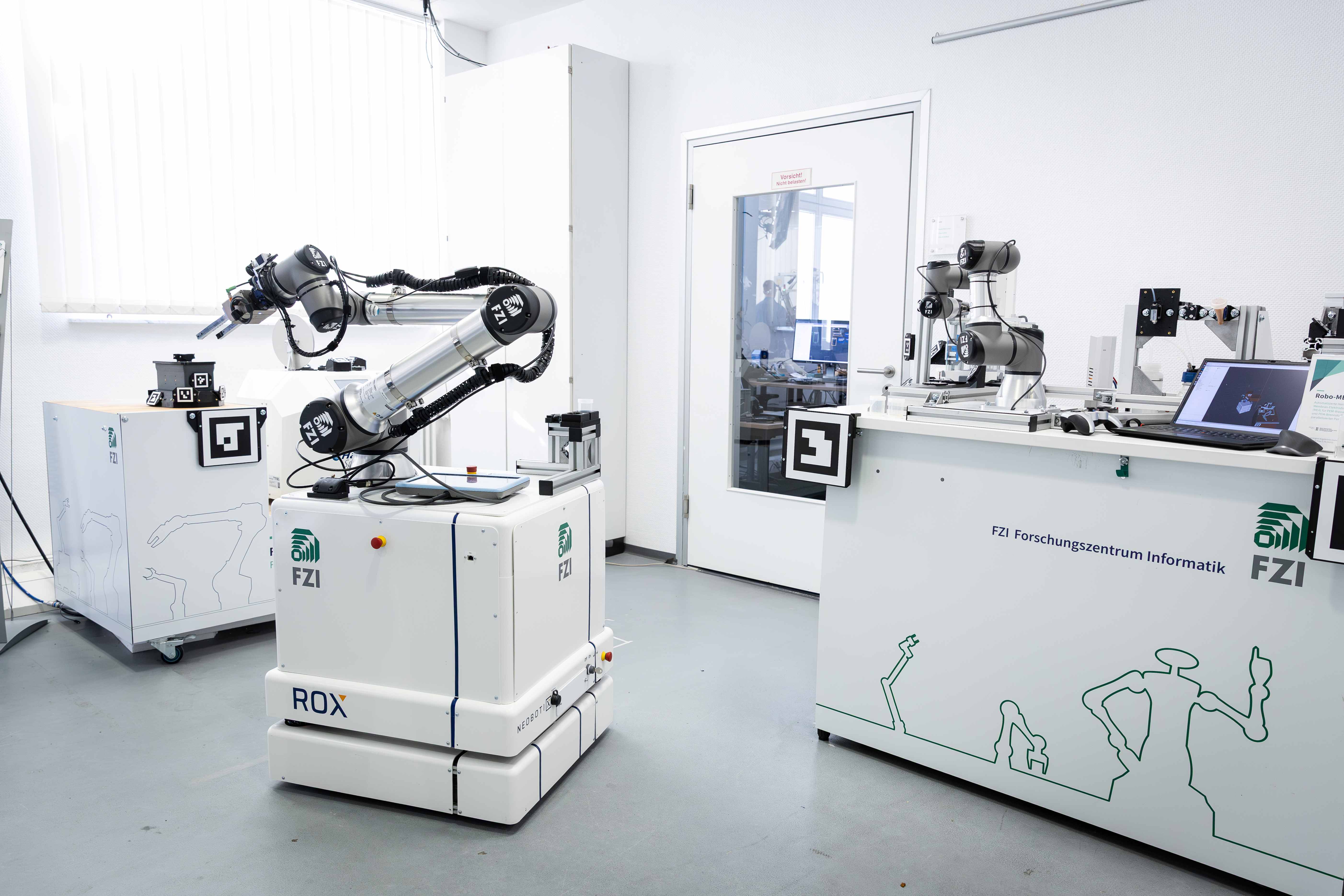

The underlying problem is typical of many industrial and research-oriented manufacturing processes: Manual procedures are time-consuming, error-prone, and only limitedly scalable. At the same time, changing requirements and varying process steps place high demands on traditional automation solutions. This is precisely where the project comes in. Methodologically, modern approaches from mobile robotics, autonomous navigation, sensor integration, and modular software architectures are employed. This is complemented by a systematic analysis and digitization of existing manual processes.
Small and medium-sized enterprises (SMEs) will benefit most, but so will larger industrial companies and research institutions seeking to streamline complex preparation or assembly processes. In addition, the project is aimed at industries where high precision and adaptability are critical—such as energy technology, materials research, and microsystems engineering. Specifically, the project aims to provide an integrated end-to-end solution that includes a mobile robot platform with reliable navigation and precise localization. The results are intended to enable users not only to implement automation processes efficiently but also to adapt them quickly to new requirements—a decisive advantage in dynamic production environments.
Finally, the FZI handles the integration and validation of the developed components within an overall system. This includes both commissioning and experimental evaluation under realistic conditions. Through this holistic approach, the FZI ensures that the developed solutions are not only technologically innovative but also practical and sustainable in their application.

AI from research to practice: We promote applied AI for business and small and medium-sized enterprises, integrating technology with law and ethics.
We develop mobile systems and autonomous walking robots for use in space travel, industry, and public spaces. We put them to the test in the FZI Living Lab Service Robotics.