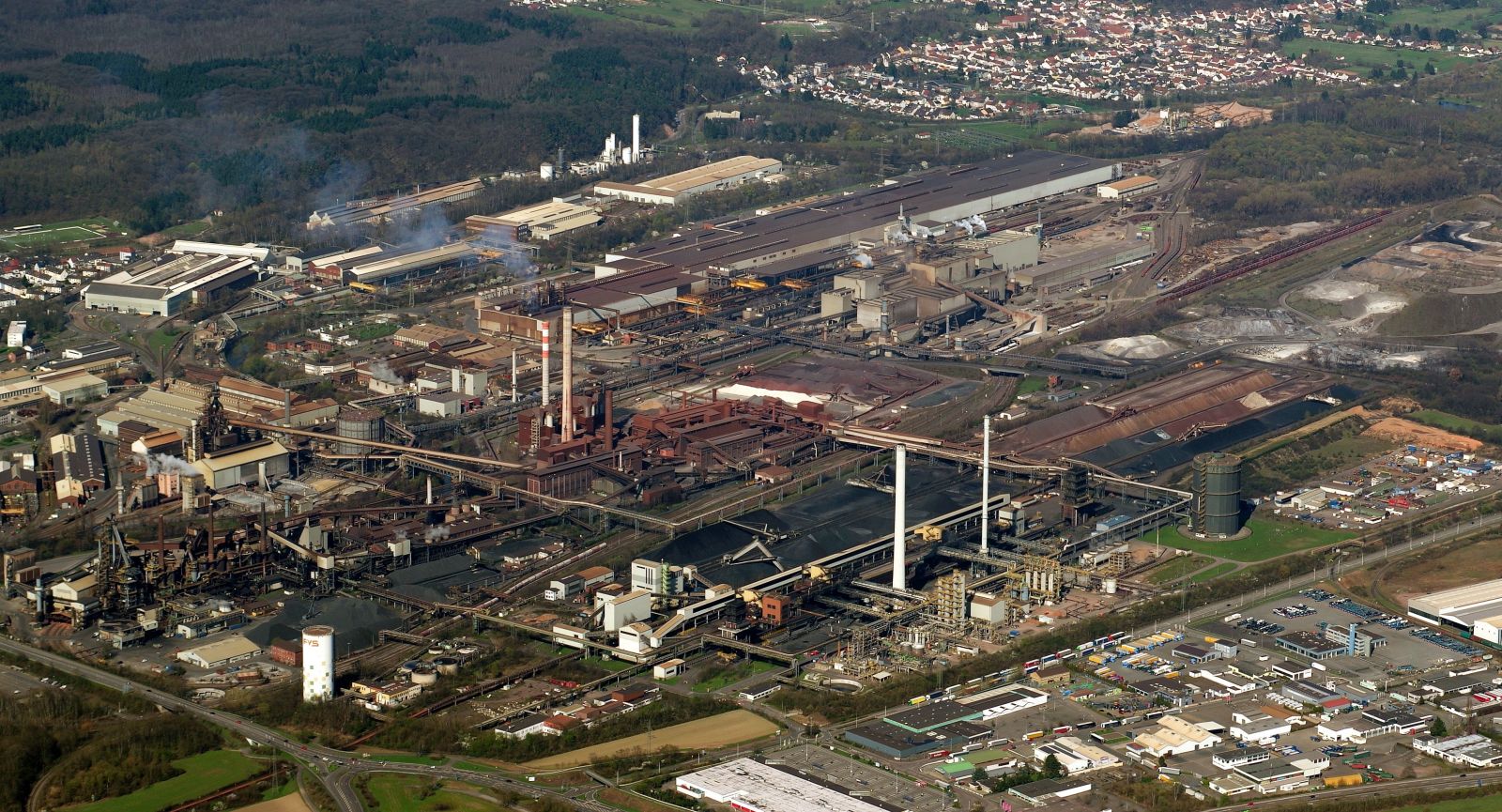

Plates, mother plates, and slabs are transported by crane and stacked between production stages. Intelligent stack formation is essential to avoid unnecessary reshuffling, waiting times, and resource conflicts. Tree-search methods are therefore investigated to jointly optimize stack configurations and crane movements.
Mother Plate Cutting Optimization
Cutting optimization involves assigning products to suitable mother plates and determining the corresponding cutting layouts. This requires a wide range of constraints to be considered, including order specifications, the technical capabilities of the cutting line, the available input material, and restrictions imposed by upstream furnaces. Column-generation methods are developed to solve the resulting large-scale combinatorial problems.
Capacity, Routing, and Scheduling
Suitable production routes and time windows are determined for each product. The planning process accounts for available plant capacity, technological requirements, planned and unplanned equipment downtime, temporal dependencies across the production chain, and customer-requested delivery windows. These planning problems are primarily modeled and solved using mixed-integer programming.
The resulting approaches provide transparency into complex interdependencies, enable the systematic comparison of planning alternatives, and support well-informed decision-making. Key objectives include reducing material waste and unnecessary reshuffling, improving capacity utilization, and generating robust and transparent planning recommendations.

Autonomous shuttles, intelligent logistics, and software-defined vehicles: We use IT to create the connected, safe, and sustainable mobility and logistics solutions of tomorrow.
Sustainability and practical relevance are key: We develop IT innovations for companies that contribute to a climate-friendly and resource-efficient economy.